↳ About FRANK

Built from the
water up.
For the community.

FRANK started as a Master's thesis. It became a question that wouldn't go away. Then a tool. Then a platform. This is the story.


My name is François Deniau. I am a freediving instructor and BJJ head coach based in Gozo, Malta — one of the Mediterranean's most remarkable dive sites. I came to freediving through curiosity, stayed through passion, and ended up dedicating my Master's thesis to understanding why people die doing something they love.

In 2018, I completed a Master's degree in Sport Sciences (STAPS) at the University of Lyon, with a thesis on deep freediving accidentology. I analysed 18 accident scenarios — from near-misses to fatalities — using the Bow-Tie method, a risk management framework borrowed from industrial safety science. My conclusion was simple and uncomfortable: the freediving community has no structured system to capture, analyse, and learn from its incidents.

Seven years later, that conclusion is still true. Training accidents disappear. Near-misses are shared in WhatsApp groups and forgotten. The information stays in closed circles. And at major competitions, blackouts are listed in results tables like performance data — then never mentioned again.

FRANK is my answer to that gap. It is not a research project waiting for funding. It is a working platform, live today at frankfreediving.org, built on the same Bow-Tie method that structured my thesis — but powered by AI, accessible to any freediver in the world, and designed to grow with the community that uses it.

The knowledge base behind FRANK is intentionally incomplete. It is a starting point, not a finished standard. The real work — co-developing that knowledge base with AIDA, CMAS, coaches, medical professionals, and athletes — is what FRANK is built for.
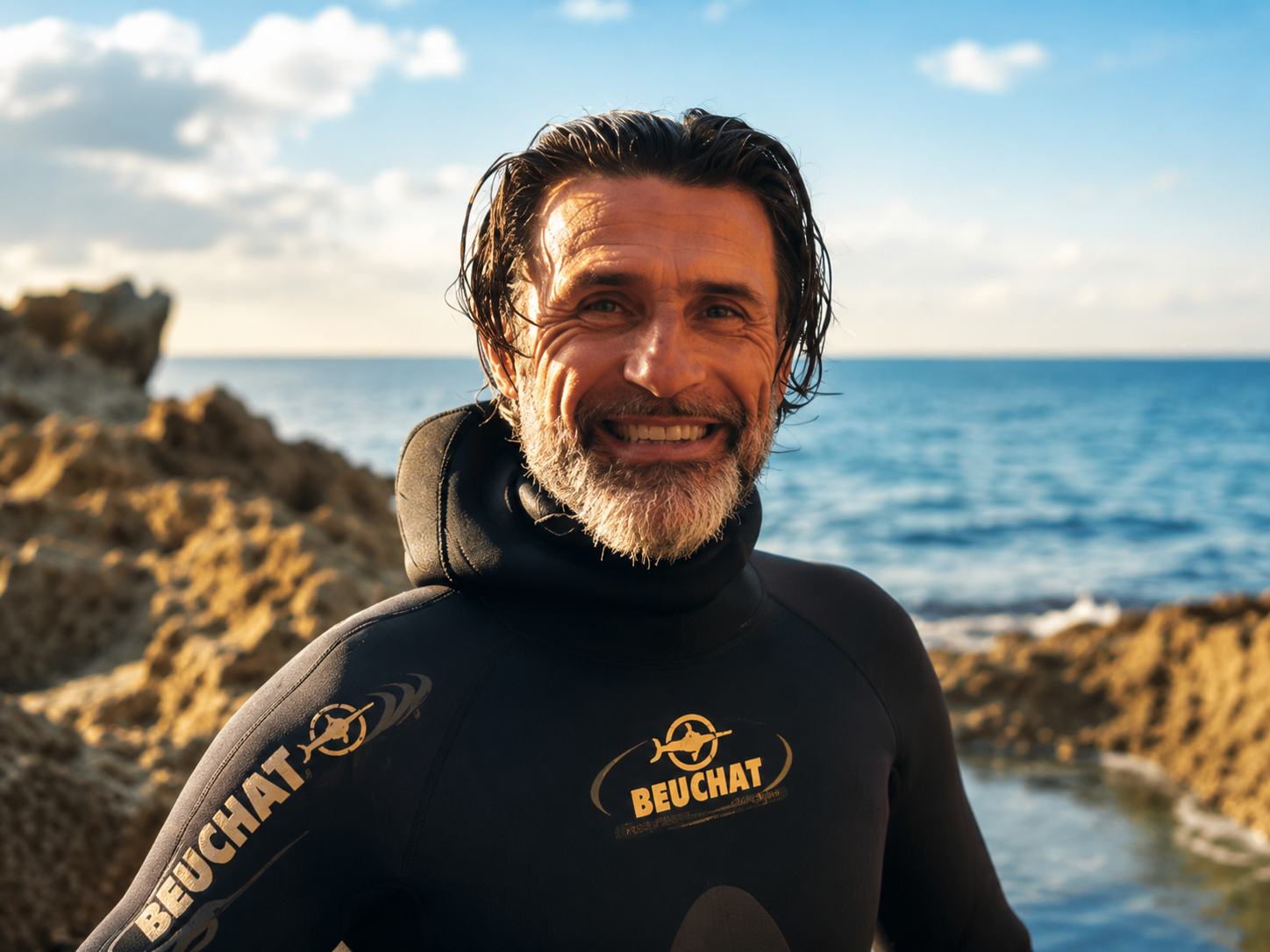
François Deniau — Freediving instructor, Gozo
François Deniau
Founder · FRANK Project

FRANK is built on the Bow-Tie method — a risk management framework developed in industrial safety and widely used in aviation, nuclear energy, and sport science. Applied to a freediving incident, it maps the full chain of events: causes and failed barriers on the left, the central unwanted event at the node, protective barriers and consequences on the right.

CauseShort surface interval after 6 prior dives
CausePerformance pressure — target depth exceeded
Failed barrierSolo training — no safety diver in water
Failed barrierNo O2 kit on site
→
Central event
Hypoxic blackout
→
Protective barrierBuddy recovered diver within 8 seconds
Protective barrierImmediate airway management
ConsequenceFull recovery — no lasting injury
Key lessonNever dive alone. No exceptions.
01
Collect
An AI-guided 7-step interview captures every dimension of an incident — profile, context, circumstances, event, factors, rescue, outcome.
02
Analyse
Each testimony is automatically mapped to a bow-tie diagram. Causes, failed barriers, protective barriers, consequences — all structured and comparable.
03
Prevent
Tailored recommendations drawn from a community knowledge base. A REX certificate to build a culture of experience sharing.

FRANK is not finished. It is deliberately not finished. The knowledge base that powers its recommendations is a starting point — grounded in my 2018 research, informed by the freediving community, but incomplete by design. Because the people who should complete it are not one researcher in Gozo. They are the coaches, medical professionals, athletes, and federation leaders who have spent decades in this sport.
"The knowledge base should be co-developed with AIDA, CMAS, and the broader scientific community. Not one person's work. A shared, living standard that evolves with the sport."
FRANK needs 100 testimonies to build a bow-tie model precise enough to generate actionable prevention recommendations. That is not a large number. With the reach of AIDA and CMAS, it is entirely achievable. And every testimony after that makes the model more precise, the recommendations more relevant, and the community safer.

Ready to
contribute?

Share your experience anonymously. It takes 5 minutes. It could save a life.

Share a testimony → Contact the team